- Home
- Residents
- Be READY Now
- Prepare Your Home
Prepare Your Home
What is the Home Ignition Zone?
The concept of the home ignition zone was developed by retired USDA Forest Service fire scientist Jack Cohen in the late 1990s, following some breakthrough experimental research into how homes ignite due to the effects of radiant heat. The HIZ is divided into three zones.
Immediate zone
The home and the area 0-5’ from the furthest attached exterior point of the home; defined as a non-combustible area. Science tells us this is the most important zone to take immediate action on as it is the most vulnerable to embers. START WITH THE HOUSE ITSELF then move into the landscaping section of the Immediate Zone.
- Clean roofs and gutters of dead leaves, debris and pine needles that could catch embers.
- Replace or repair any loose or missing shingles or roof tiles to prevent ember penetration.
- Reduce embers that could pass through vents in the eaves by installing 1/8 inch metal mesh screening.
- Clean debris from exterior attic vents and install 1/8 inch metal mesh screening to reduce embers.
- Repair or replace damaged or loose window screens and any broken windows Screen or box-in areas below patios and decks with wire mesh to prevent debris and combustible materials from accumulating.
- Move any flammable material away from wall exteriors – mulch, flammable plants, leaves and needles, firewood piles – anything that can burn. Remove anything stored underneath decks or porches.
Intermediate zone
5-30’ from the furthest exterior point of the home. Landscaping/hardscaping- employing careful landscaping or creating breaks that can help influence and decrease fire behavior
- Clear vegetation from under large stationary propane tanks.
- Create fuel breaks with driveways, walkways/paths, patios, and decks.
- Keep lawns and native grasses mowed to a height of four inches.
- Remove ladder fuels (vegetation under trees) so a surface fire cannot reach the crowns. Prune trees up to six to ten feet from the ground; for shorter trees do not exceed 1/3 of the overall tree height.
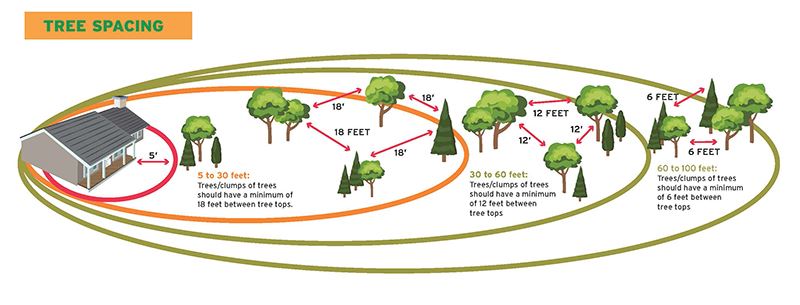
- Space trees to have a minimum of eighteen feet between crowns with the distance increasing with the percentage of slope.
- Tree placement should be planned to ensure the mature canopy is no closer than ten feet to the edge of the structure.
- Tree and shrubs in this zone should be limited to small clusters of a few each to break up the continuity of the vegetation across the landscape.
 Extended zone
30-100 feet, out to 200 feet. Landscaping – the goal here is not to eliminate fire but to interrupt fire’s path and keep flames smaller and on the ground.
- Dispose of heavy accumulations of ground litter/debris.
- Remove dead plant and tree material.
- Remove small conifers growing between mature trees.
- Remove vegetation adjacent to storage sheds or other outbuildings within this area.
- Trees 30 to 60 feet from the home should have at least 12 feet between canopy tops.*
- Trees 60 to 100 feet from the home should have at least 6 feet between the canopy tops.*
*The distances listed for crown spacing are suggested based on NFPA 1144. However, the crown spacing needed to reduce/prevent crown fire potential could be significantly greater due to slope, the species of trees involved and other site specific conditions. Check with your local forestry professional to get advice on what is appropriate for your property.
HOW TO PREPARE YOUR HOME
VEGETATION MANAGEMENT
1. HOME IGNITION ZONES
To increase your home’s chance of surviving a wildfire, choose fire-resistant building materials and limit the amount of flammable vegetation in the three home ignition zones. The zones include the Immediate Zone: (0 to 5 feet around the house), the Intermediate Zone (5 to 30 feet), and the Extended Zone (30 to 100 feet).
2. LANDSCAPING AND MAINTENANCE
To reduce ember ignitions and fire spread, trim branches that overhang the home, porch, and deck and prune branches of large trees up to 6 to 10 feet (depending on their height) from the ground. Remove plants containing resins, oils, and waxes. Use crushed stone or gravel instead of flammable mulches in the Immediate Zone (0 to 5 feet around the house). Keep your landscape in good condition.
FIRE RESISTIVE CONSTRUCTION
3. ROOFING AND VENTS
Class A fire-rated roofing products, such as composite shingles, metal, concrete, and clay tiles, offer the best protection. Inspect shingles or roof tiles and replace or repair those that are loose or missing to prevent ember penetration. Box in eaves, but provide ventilation to prevent condensation and mildew. Roof and attic vents should be screened to prevent ember entry.
4. DECKS AND PORCHES
Never store flammable materials underneath decks or porches. Remove dead vegetation and debris from under decks and porches and between deck board joints.
5. SIDING AND WINDOWS
Embers can collect in small nooks and crannies and ignite combustible materials; radiant heat from flames can crack windows. Use fire-resistant siding such as brick, fiber-cement, plaster, or stucco, and use dual-pane tempered glass windows.
6. EMERGENCY RESPONDER ACCESS
Ensure your home and neighborhood have legible and clearly marked street names and numbers. Driveways should be at least 12 feet wide with a vertical clearance of 15 feet for emergency vehicle access.
- Develop, discuss, and practice an emergency action plan with everyone in your home. Include details for handling pets, large animals, and livestock.
- Know two ways out of your neighborhood and have a predesignated meeting place.
- Always evacuate if you feel it’s unsafe to stay—don’t wait to receive an emergency notification if you feel threatened from the fire.
- Conduct an annual insurance policy checkup to adjust for local building costs, codes, and new renovations.
- Create or update a home inventory to help settle claims faster.
OTHER CONSIDERATIONS
- Store firewood away from the home.
- Mow the lawn regularly
- Prune low-hanging tree branches
- Landscape with fire-resistant plants
- Create small fuel breaks with hardscaping features
Download the How to Prepare Your HomeFor Wildfires HERE. Visit www.FIREWISE.org for more details.